Friday, April 05, 2013

Tomato soup

“It’s always ourselves we find at the sea.” I inhaled a lot of ee cummings when I was a teenager, and this line comes back to me as I dig through Independence Day, finding poems. If you gave a group of poets the same page, they’d each come back with different poem. 

The shaky thing about this project is everyone’s daily poem is instantly published! Most of my Pulitzer Remix poems wouldn’t be poems I’d submit. They’re just there. In the time allotted to me, I found them. I wrote them down. I bow humbly to my limits.

Today at work, in a different but similar scenario, I repeated my favorite, widely applicable Andy Warhol quote (that I possibly made up): “This is a soup can. We must make do with what we have.” 

Here are my five poems so far: 

Time! is my theme these days, as in it's flying. At the moment(s) I am trying to get through The Finkler Question before traveling to NJ tomorrow. As always before a trip, I don’t want to board the plane with a book I’ve nearly finished. I prefer to arrive at the airport with FRESHBOOK. Besides, ahead of my trip, I ordered enough books, deliverable to my mother, for a suitcase library. She has begun reading one, which appeals to my inner thrift-monger.

Sunday, March 31, 2013

Dilly dilly

I found out a couple days ago that my poem “In the Voice of a Minor Saint,” which was the title of my first chapbook, will be published in an anthology of poems about saints. The working title is The Lives We Seek: Contemporary Poems Inspired By the Saints, to be published by Ave Maria Press. I am by far the least famous poet in the table of contents, so my poem title is fitting. Among the luminaries are James Tate, Martha Silano, Dana Gioia, Edward Hirsch, Kelli Russell Agodon, and scads of others, while the saints include St. Anthony, St. Agnes, St. Peter, St. Rita, Big Sur Saints, the patron saint of lost & found, and St. Nick. It’s due out next April, and I can’t wait.

Otherwise, here it is Easter and the family males are en route for home. I’m roasting a chicken. Last year I mistook the lavender branches in the garden for rosemary and we had lavender chicken. In winter those plants look quite similar! The chicken was more whimsical, perhaps, but not as tasty. 

I’ll be leaving myself in a week for NJ to visit my mother for her birthday. In the meantime, the Pulitzer Remix kicks off tomorrow - 85 poets writing a found poem a day, each from their assigned text. I will post occasional reminders to read!

Friday, March 29, 2013

Easter weekend

I have spent many days alone, the family scattered north and south - Lulu in Berlin, and the boys in the boot heel of Italy visiting relatives. Even the dog spent the last week in the countryside with friends, since work kept me from walking her regularly. Lulu came back this evening, bearing souvenirs from Die Brücke museum and asking for sushi takeout. She brought me this notecard of a painting by Walter Gramatté, who died of at the age of 32 of tuberculosis.

I had a friend over last night who told me of her travails with online dating, and how the most promising of her beaus gave her a book that dealt a fatal blow to a budding relationship. He was otherwise a promising guy, but about three dates in her gave her a “relationship guidebook” for her birthday, which she was unable even to unwrap completely, so horrifying was the title. He knew she liked to read, and meant it as a nod to that, but fell very far off the map and was dismissed from the stage. 

My husband and I have many differences, being from different continents, religions and temperaments, but I cannot fault his taste in books. He did buy me a terrible book once, in ignorance, but later read it himself and admitted it was terrible. He also prefers David Copperfield to Great Expectations. Well, in moments of weakness even I prefer David Copperfield to Great Expectations.

Elsewhere, I've lived in Germany for 20 years and never knew it was forbidden to dance on Good Friday! It's interesting how atheist Europe sticks to these fossilized rules, like all retail stores being closed on Sundays, while the fundamentalist Christians in America stop at Sam's Club or whatever after church to pick up some booze. 

Saturday, March 23, 2013

I’ve nearly finished combing the white through my hair

In the name of confronting what makes you uncomfortable, I spent the night wrenched around myself, my pajama pants creeping to my knees to make my calves cold, my turtleneck too snug at the throat. I lay flat down on my belly because it is my favorite position although it makes it difficult to access fresh air and I wake with a kink in my neck and into my shoulder. Who said fresh air was free? Who suggested sleep should bring rest? And in the morning I woke a 5.55 am, although it is Saturday, to put my daughter on an uneasy bus to Berlin for a week because she said so.

Wednesday, March 20, 2013

A possible ending

I finished The Sense of an Ending by Julian Barnes on Monday. I had the day off, which I enjoyed gratefully, and read the last half or so sitting at my desk with all my papers, pens, mugs and other books strewn around as if I were the live participant in a vertical live burial.
Right after I finished I was so befuddled, I sat pressing my eyebrows with my fingertips, wondering if what I thought just happened happened, and came to the inescapable conclusion that it did. It was one of the most affecting reading experiences -story-wise- that I've had in a hugely long time.
One thing that makes The Sense of an Ending so effective is the easy pacing and sympathetic narrator.
You're ill-prepared for the shock.
My daughter walked in to my room right as I had accepted the hypothesis, and said something mundane like, 'I need some money,' then stopped and said, 'What's wrong with you?'
I made a sweeping gesture towards the bed, where the book lay.
'Oh my god,' I explained.
I know there is another very plausible theory about the plot of this book, but I'm not buying it.

Tuesday, March 19, 2013

Soares

Opening sentences of The Book of Disquiet

Installed on the upper floors of certain respectable taverns in Lisbon can be found a small number of restaurants or eating places, which have the stolid, homely look of those restaurants you see in towns that lack even a train station. Amongst the clientele of such places, which are rarely busy except on Sundays, one is as likely to encounter the eccentric as the nondescript, to find people who are but a series of parentheses in the book of life.
There was a period of my life when a combination of economic necessity and a desire for peace and quiet led me to frequent just such a restaurant. I would dine at around seven each night and, as chance would have it, I was almost always there at the same time as one particular man. (translated by Margaret Jull Costa & William Boyd)

Lisbon has a certain number of eating establishments in which, on top of a respectable-looking tavern, there’s a regular dining room with the solid and homey air of a restaurant in a small trainless town. In these first-floor dining rooms, fairly empty except on Sundays, one often comes across odd sorts, unremarkable faces, a series of asides in life.
There was a time in my life when a limited budget and the desire for quiet made me a regular patron of one of these first-floor restaurants. And it happened that whenever I ate dinner there around seven o’clock, I nearly always saw a certain man who didn’t interest me at first, but then began to. (translated by Richard Zenith)

Há em Lisboa um pequeno número de restaurantes ou casas de pasto [em] que, sobre uma loja com feitio de taberna decente se ergue uma sobreloja com uma feição pesada e caseira de restaurante de vila sem comboios. Nessas sobrelojas, salvo ao domingo pouco freqüentadas, é freqüente encontrarem-se tipos curiosos, caras sem interesse, uma série de apartes na vida.
O desejo de sossego e a conveniência de preços levaramme, em um período da minha vida, a ser freqüente em uma sobreloja dessas. Sucedia que quando calhava jantar pelas sete horas quase sempre encontrava um indivíduo cujo aspecto, não me interessando a princípio, pouco a pouco passou a interessar-me. (Fernando Pessoa)

Saturday, March 16, 2013

Appendix II, footnotes

72 “Anywhere,” where Schopenhauer wished to be buried 

73 “the cellulose sky glows but cannot shine” (alt version the membrane unstretched let little light in

74 “it’s normal to go about crying in those towns,” thought to refer to Saxony 

75 dismal park, a stretch between the house and the tram peopled with juvenile delinquents 

76 “a gaze like time” (alt version quietness of time

77 (missing text) 

78 che cazzo, an Italian curse, expressing disgust 

79 “our motto” refers to the ashes motto, Fahrenheit 451: “Monday, we burn Miller; Tuesday, Tolstoy; Wednesday, Walt Whitman; Friday, Faulkner; and Saturday and Sunday, Schopenhauer and Sartre. We burn them to ashes and then burn the ashes. That's our official motto.” 

80 Kantstraße, a cobblestoned side street, languid, morose and antique 

81 11/22/63, JFK assassination 

82 “our age, overabundant rot” (alt version the era of Sturm und Dreck

83 Trinkhalle, a kiosk selling beer and snacks, ubiquitous city fixture 

84 McPherson, a small, church-pocked Kansas town 

85 Sor Ursula, mathematician and former Spanish nun who said, “I am sure only of doubt” 

86 “forgotten as the war, and gladly” - the Korean war, often called the forgotten war 

87 “9 o’clock underwater” refers to the painting Fish Magic (Philadelphia) 

88 I tend to loose friends, thought to mean “lose” 

89 Schiller’s rancid wallpaper refers to the chemically-treated wallpaper in Schiller’s Weimar rooms, thought to have hastened his death 

90 “the pompous sunset of the West” (alt version orange demise

91 In answer to JRJ, “if you ‘lived’ another year after your death you would see all your revision was pointless.” 

92 “I would go with my despair to an upstairs room” (previous version downstairs)

Thursday, March 14, 2013

Bohemian

The review of my chapbook, Homebodies, gone missing some two weeks, has been located.

Wednesday, March 13, 2013

Extra Texture

It is Wednesday, the third day of the work week. And in Europe, work’s over. 
Starting now, I have three working days off. I have let the basking begin. 

I also have three poems in the new Otis Nebula: Mermaids, Box of Sneezing and Dead Headlights

Mermaids is composed largely of notes I took last year in New Mexico, where I visited the Oppenheimer nuclear museum at Los Alamos, and the folklore museum, where I found the quote about Columbus. The TB stuff is spun off Oppenheimer, and the Emma Goldman anecdote is something my father told me while I was there. He is an Emma Goldman scholar. 

The New Mexico connection is why I like the 2 of Hearts cactus card that is on my page so much. 

Box of Sneezing is about the texture and sensation of sneezing. 

Dead Headlights began from what was originally a line in a ghazal that I made into its own poem.

Tuesday, March 12, 2013

Somniloquism

When I woke up, the 12-word poem I wrote last night was still okay. And that was a good beginning. 

Yesterday the cold came back, along with the filing cabinet-grey sky. But today we awoke to snow, gobs and gobs of it, and still going. It is the best, biggest snow in a long time. 

This morning I crossed the park at dog hour, the time of morning when people make the rounds with their best friends. There was a lanky, loping woman with a lanky copper-colored dog. There was our squat neighbor in his woolen cap with his little dog. Squat, I thought, was just the word for him. It does not mean he is overweight, only indicates a certain circumference/height ratio. 

On the train, I read yet another review of George Saunders’ new collection of stories. The reviewer said some readers would already be familiar with Saunders' “gonzo ventriloquism,” and it struck me that I dislike the word gonzo a lot, and for me it doesn’t describe Saunders. I do like words that end in “-quism,” though. All two of them.

We saw “The Master” on Saturday and were underwhelmed. The cinematography was good. Each actor was impressive, but the chemistry between them and the story didn’t gel. It lacked the intensity you’d expect in a movie about a cult. The lost soul didn’t seem to need religion. It was unclear what the cult leader wanted in the lost soul, and he didn’t exercise real control over him. There were throwaway moments, like the party where the women were naked. To convey what? Lechery? Lasciviousness? Nowhere in sight! 

Add it to the list of big-promise underwhelmers we’ve seen lately: Les Miz, The Impossible, and, yes, Lincoln. Lincoln was the best of them, but dressed-up hokey celebrate America, if you ask me.

Saturday, March 09, 2013

Mimeo

I have surely told this story before but it’s one that returns to me. When we were young, my step-brother would buy multiple copies of certain books to show how much he loved them. You’d find three copies of Catch 22 on his shelf, for example, and roll your eyes. But it was also endearing, and I remembered it again today when I got up the chutzpah to rip a page out of Independence Day to do an erasure I could scan and post, but then proceeded to botch the project. I taped the page back in the book, pathetically, black stripes and all, and began cruising Amazon for used copies since I’d like to have one whole. In fact it would be good to have three copies: one as a readable book, one to mark up and underline, and another to rip apart and black out.

It’s not a bad idea to have duplicates and triplicates of things you love. I know when a beloved pair of shoes bites the dust I kick myself for not having bought two pairs. I also think it would be nice to have three copies of certain books I depend on - one in the bedroom, one beside the kitchen table, one in my study. I could also be less lazy and better organized, but there's only so much time to improve one’s character, and the priority is sometimes to improve one's life. 

Thursday, March 07, 2013

For remorse, there is no consolation

At the moment I find myself in the untypical situation of reading five books simultaneously: an English novel, a book of aphorisms, a fictional autobiography, a series of observations and essays by a French composer, and of course Richard Ford’s Independence Day.

The Pulitzer Remix has hijacked my time. The project has its own Facebook page and every time I check in I feel like I’m in Fahrenheit 451, charged with the care of a single book. “Hello, my name is S. Jane and I am Independence Day.” Or who/whatever. 

Though content with my choice, I do suffer book envy. I took Independence Day because I thought it would be interesting to revisit why I’d liked it so much, but it wasn’t my favorite book on the list. That would be the gorgeous and powerful The Confessions of Nat Turner

Nor is it the book that influenced my life most. That would be The Good Earth, which I read in junior HS and decided if I ever did anything I would someday live in China. There was one scene in it where I believe the mother or father of a newborn hides the child under their coat, proclaiming what a piece of crap baby it is, hardly worthy of ye gods’ attention. I identified with that very strongly and still do. The superstition against pride. 

I’m also reading the novel Old Filth, a novel I bought because of the crazy title and came to dread reading, but which is proving extremely worthwhile. And I’m reading The Complete Perfectionist, a collection of aphorisms and such by Juan Ramon Jiménez. It is also a worthwhile read for writers and poets and anyone who happens to be alive. 

“The only bad part of death must be the first night.” 

“When you’re working on one thing and start to yearn for another, imagine that this thing you’re working on would be the one you yearn for if you were working on the other.”

“For remorse, there is no consolation.”

Saturday, March 02, 2013

Independence Remix

I’m participating in a project called Pulitzer Remix, hosted by the Found Poetry Review. You can see the blue swag swagging over there to the left on the blog. Poets taking part are assigned a Pulitzer Prize-winning novel, and set out to unearth 30 poems, whether through erasure or collage or dada. The poems will be posted throughout April.

Some poets steered away from books they’ve read, giving them the distance to find poems independent of plot and character. I didn’t choose that route because I can only use a book I have access to, meaning it’s here in my house, which in most cases means I’ve read it. 

My book is Richard Ford’s Independence Day. It won the Pulitzer the year my daughter was born, and I read it almost as long ago. I liked the book very much, but never pursued Ford’s other books. I read a story of his called “Puppy” a few years back that was exceptional, and after Canada came out I read that, too. At the time I was reading it in October, I ran into Richard Ford at the Frankfurt Book Fair, meandering among the French publishers. I looked at him so hard he couldn't avoid looking back at me. I had a “wow is he gorgeous” moment, then turned around walked the other way. 

Anyway, here I am getting intimately acquainted. Finding poems is not easy. You need to let go and shake the text up in your head so that it stops being part of something already well formed. Check out Dave Bonta's erasure project on Samuel Pepys' diaries at Via Negativa. He has taught me a thing or two.

Thursday, February 28, 2013

Thoughts on clapping

My thoughts on clapping are there’s been enough of it, and the act should be executed, if at all, in moderation.

Not that I don’t appreciate good performances. Not that I don’t want to honor what’s honorable. 

But let’s not pretend that the school band is Maria Callas. 

And let’s not pretend Maria Callas was perfect, or never wished after singing just to mosey on home.

What I don’t like is when clapping becomes a public test of enthusiasm. My aversion to it shouldn’t belie a lack of admiration or fan-feeling. Didn’t you see me last week weeping through an amateur orchestra’s rendition of Bach? 

I simply like a gesture delivered in appropriate doses. I like the efficient flutter of clapping that issues the thank-you note and releases me to go. 

Especially distasteful is when the wanton smacking together of hands goes from tribute to demand.

What I don’t like is sitting through a string of encores. 

What I don’t like is when the performer forgets all modesty. It is nice to be acknowledged, but one should also examine oneself critically. 

Have I ever mentioned the poet who, upon receiving the first copy of his book, ripped the pages from the spine and started every poem over?

Sunday, February 24, 2013

Lakritz

We went to hear three Bach cantatas (105, 54, 182) today, none of which I was familiar with. Of course they were gorgeous, the music so grave and poignant.

I was annoyed with the prattle of the conductor before they began - what a different world Bach lived in, the church, piety, and blah blah blah. “Your dead gods tell me nothing,” I said with Pessoa. 

I went through the lyrics in the handout and made up some fake ones (“Lord, don’t take that beef to court,” “God, you hold the sandpaper and the tanks approach,” etc.) to amuse myself, but when the first strains of music rose I was sure I would weep. I cleared my throat (quietly) instead. 

Listening to Bach cantatas is like having a heavy strand of the blackest licorice pulled back and forth through your ears. Rest assured the friction will build and it will get warm enough for those sweet, dark beads to drip down the back of your throat.

Monday, February 18, 2013

Ways to feel

A technicolor sunset brings a feeling of baffled insecurity. There’s always a shade of atomic orange, tinged with pink or violet and glossy splashes of black. People make posters of this phenomenon, adding inspirational messages. Maybe I’d have appreciated such sunsets in another age? It’s not that they’re not beautiful - it’s just they require so much emotional coping. 

Fremdschämen. Yet another German word you need 8+ words to explain. It describes the feeling of being ashamed for someone else, especially if they themselves are not. It should precede any ingestion of the secret pill that transforms you into a dog, sparing you from belonging to the human race. Silvio Berlusconi is a major producer of this feeling. You can also experience it watching the Eurovision Song Contest. 

Dogs supposedly activate hormones that soothe people and cheer them up. I believe this as long as the person is near suicide or otherwise vulnerable to the charm. However, if it is 9 pm and freezing and time to walk the dog, the hormone trick proves ineffective. 

Rain manages the most intimate. It finds you, it sinks into you, it gets to know your crevices. Like any erotic attention, sometimes it’s welcome, and sometimes you wish it would lay off. 

When I cannot finish a poem despite months even years of trying it makes me feel like I have folded 32,258 origami swans very badly and what should I do should I go out and burn them? 

Wind makes me feel alone, in a good way.

Friday, February 15, 2013

Inksuite

I have a new chapbook. Isn’t it gorgeous? “Inksuite,” it’s called, and the cover art is by Emmanuel Polanco, the Parisian collagist. He recycled the cover of an old book to make this collage, which shows a schoolboy standing in an odd little garden of objects, holding what appears to be a textbook. From above, ink comes raining from a cloud formed by a worn-away edge of the cover. I love the elements -- the geometric plaid, the Sphinx, the one wing, the scribbles, and the gash. Thank you to Emmanuel.

The poems all have to do in some way with reading and books, and also with typefaces and the written word. The poem “On Receiving a Rejection Note One Year and Seven Months after Submitting” is included for its mention of runes, for example. There are poems about specific books, and as always I included some ghazals - “Book of Hours Ghazal” and “Flip-Book Ghazal,” which was recently published by Kestrel

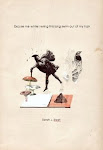
You can order the chap at Dancing Girl Press for $7 (plus postage). You can also do DGP’s bundle deal and order any five books for $25, which is a good way to discover new poets. You could even include my previous DGP chap “Excuse me while I wring this long swim out of my hair” in it! I also recommend J. Hope Stein’s “Talking Doll,” which I just read, and “Boom of a Small Cannon” by Mary Ann Samyn. I loved both those chaps. You wouldn’t have to leave the letter S!

Thursday, February 14, 2013

Valentine is the patron saint of epilepsy

Charles Dickens wanted a woman with oomph on his arm, but his wife Catherine was reserved and rather a homebody. You might excuse her considering she had 10 children. One would have hoped Charles could have set her up and parted amicably so he could court Ellen Terry, the young actress; instead he belittled and exiled Catherine, and blamed her for so much birthing. Though history points to the contrary, I like to think she was relieved to be rid of him.

Abraham Lincoln remained loyal to Mary, although she was less competent than Catherine Dickens and as dowdy. And Hilary Clinton remains loyal to Bill, despite his womanizing. There’s more to love than sex, the saints say. 

The less you know about people’s relationships, the better the relationships seem. Anyone care for more Sylvia & Ted?

“We’ve Only Just Begun,” the Carpenters’ song played at millions of weddings including my aunt’s (later legally terminated), was originally written for a bank commercial. Karen Carpenter, coincidentally, died the day her divorce went through. 

John Keats might have happily wedded Fanny Brawne if he hadn’t wasted away from TB. Fanny’s own brother also died of TB a few years later. TB is an ardent suitor. Which reminds me to read The Magic Mountain

Fernando Pessoa seems to have never loved anyone at all, on purpose. 

Erik Satie, too, made a clean break. His one love affair, with Suzanne Valadon, left him heartbroken, and Satie abandoned romance. He died of cirrhosis, and the posthumous excavation of his lodgings revealed excrement on the living room floor. Perhaps he didn’t want to venture too far from the piano? Which remained true to him?

Tuesday, February 12, 2013

To think with

I have a poem up at Barnstorm called Salem, which is of course a brand of cigarette as well as a town most famous for burning witches. I wonder if this potential association was taken into account when the name was chosen, or if it was chosen deliberately for that reason, Salem being a cigarette marketed to women. Many women must go for the subliminal witch message, witches being powerful, and women in general lacking power. But I digress.

Anyway, the inspiration for the poem comes from Herta Müller’s The Land of Green Plums

“Mother didn’t put down her knife while eating, even though everything had already been cut into bite-size pieces. She needed it to speak with.” (p. 142) 

I found that striking - needing a knife to speak with. Like a microphone, or a pointer, or just the extension of a thought. I love the image of someone speaking with a knife. You will recognize the phrase in the beginning of my poem, but that’s about all it has to do with The Land of Green Plums.

Sunday, February 10, 2013

the blood-sucking sun

As if part of some cosmic joke, we have had two straight days of sunshine, beginning exactly at the moment a US news outlet said solar energy won’t work there because it’s not sunny like Germany. From the dim northern coast to the overcast border town of Regen (“Rain”), that expert reporting caused the whole of Germany to erupt in a wet, grey guffaw. In fact, from what I’ve read, even the sunniest spot in Germany can’t hold the proverbial candle to the US. How (and where) else could Weltschmerz have been invented?

Anyway, yes. My son asked me at breakfast to please draw the shades, raising the back of his hand to his eyes like a vampire being drained of strength. The sun is confusing. What if it reveals something to us? Like how dirty our windows are, or the cobwebs fusing the piano to the liquor cabinet? Or something even worse, and more personal? 

Coincidentally, it is Carneval weekend, what most of the world calls Mardi Gras. The Rhine is the magnet for Carneval partiers - Mainz and especially Cologne. Maybe we’re enjoying this sunshine in preparation for a long, dark period of fasting? 

Coincidently, I’m reading Heinrich Böll’s Group Portrait with Lady, set in Cologne. I read it in college decades ago and remembered liking it, despite the lackluster leadership of our literature professor. Re-reading, I find out it is post-modern. Of course it was post-modern in 1984, too, just at that time I didn’t have the faintest idea what that was. So good was our professor! (I’m sure he didn’t know either.) In his defence, he was a German professor and not a literature professor. Which is fortunate because he really sucked at teaching literature. You know that winners of the Nobel Prize for literature don’t win for any particular book, rather they win for a body of writing. Still when Böll won the Nobel Prize, the committee cited Group Portrait as the “crown” of his work.

Song of the day: Was a Sunny Day

Wednesday, February 06, 2013

Wild Horses

Knowledge is power. Wisdom is power.
Talent is also power, as is skill, such as that of hackers.
Charm wields power because it is a kind of influence, which is a synonym for power.
Hope is not power, unless it is transformed into ambition.
Ambition is power.
Electricity is power (joke).
Physical strength of course is power, thus "horsepower."
Truth is power if one chooses to bare it, but unfortunately money is also power.

Monday, February 04, 2013

They paved paradise

So, I am satisfied. Give me a bowl of wine.
I have not that alacrity of spirit
Nor cheer of mind that I was wont to have.
Set it down. Is ink and paper ready?
Act 5, Scene 3

Ah, Richard III! The bones of the last Plantagenet king were found buried under a parking lot. How extremely interesting. Made being alive today worth it. That and my own glass of wine, and pen, and ink. 

Sunday, February 03, 2013

Sonntag

the swaying pines of the neighbor’s yard, the gloom of their green,

the purlieu of dust, a close inspection of fingernails, parcels of money for allowance, lunches and tutoring, 

the stoic pose of the radiator, the aftermath of caffeine, 

a spent tube of handlotion, hours of go-nowhere evaluation, the patron saint of long silence, a stack of CDs, 

vines of dead wisteria, the busy noises of other floors, 

stray sheets of paper, a crumbling copy of Alice in Wonderland, a wave of fatigue, beloved jar of buttons, the poison of feeling secure, 

the click of the dog’s claws, melodrama of teenagers, the shape of the keyhole, an almond, the key, 

bathtub of blue water, landscape of mussed bedding, the vague passage of time, the damp of washed hair, the smell of soap, of toast, of pencil shavings, 

an empire of bookshelves, the deepest of breaths, 

the chance of good luck, of ill luck, the dire lack of sun, the sweep of a sleeve, the fur-grey of February,

Wednesday, January 30, 2013

from the homeward commute

Coming home on the crowded UBahn I am glad to find a seat. My knees, if I didn’t turn them slightly, would touch those of the woman across from me. She has firm legs, but lined with blue veins and blotchy. Over them she has put on a pair of low-sheen mustard-colored hose. This is really unattractive, but also fascinating, and I realize it's because clad this way those legs resemble my beloved Stilton cheese.

Tuesday, January 29, 2013

Bubbles

I recently finished a John Banville’s Kepler, and yesterday began The Infinities, which is first off remarkable for its beautiful deep eggshell blue cover. I’ve read some reviews by readers who find Banville pretentious (because of his vocabulary? because there are Greek gods hovering in the narrative?) but I think he’s marvelous. Take this passage, about a boy getting a clay pipe that blows bubbles: 

"At first he could not get the hang of it then suddenly did. The bubbles hesitated on the rim of the pipe-bowl, wobbling flabbily, then broke free and floated sedately away. They seemed to be rotating inside themselves, as if the top was always too heavy, and the iridescent surplus kept cascading down the sides. Sometimes two of them stuck together and formed a fat, trembling shape something like an hourglass only squatter. They were made of an unearthly substance, a transparent quicksilver, impossibly fine and volatile, rainbow-hued. They popped against his skin like wet, cold kisses."

Friday, January 25, 2013

Rioja

So glad it's Friday.
The Spanish wine I like was on sale.
I picked up two chunks of my favorite cheeses (Fontina & Stilton).
The next episode of Sherlock awaits.
And I'm very happy to share this review of Homebodies from The Rumpus.
AND I don't have weekend duty...

Thursday, January 24, 2013

Word Thursday

The 2012 word of the year in America was hashtag, which is a good word in terms of sound and suggestion, even though what it denotes is a yawner. Soundwise, with its two tight /ae/s, it is like a dentist asking you to open wide, twice. In terms of meaning, hash evokes aromatic resins and potato products, while tag suggests it's for sale, used. Still, the hashtag itself, referring to the # symbol used on twitter posts, is kind of a sad comment as word of the year, I think. To use two more /ae/s, #flashinthepan.

Germany also had a word of the year: Rettungsroutine. Like hashtag, it’s a compound word consisting of Rettung, or rescue, and Routine, the same in English. Specifically it means going through the never-ending motions of rescuing the eurozone with summits, pep talks, bailout money, and warnings about austerity. 

Germany also had an “unword” of the year, which a jury of linguists chooses as the year’s worst or most unfortunate word. In 2012 it was Opferabo. Once again, it’s a compound word. (I guess it’s tough to get attention as a free-standing word anymore.) Opferabo literally means “victim subscription,” or “subscription to victimization.” It started with a weatherman who was accused of rape, who said that in society women enjoyed a sort of “victimization coupon,” their image as perennial victims being an ace up their sleeve that allows them to accuse men of abuse. 

The jury chose Opferabo as the eye-rolling word of the year because it stereotypes women as sly users trying to take advantage of a perceived disadvantage, while ignoring the fact that only a small percentage of women who are sexually abused or raped ever actually report it.

Wednesday, January 23, 2013

Walk on by

If it were my inauguration, Dionne Warwick would be singing Burt Bacharach. Actually singing, whether she felt like it or not. And my inaugural poet would be Charles Simic, who could just read from The World Does Not End. No need to write some pathetic occasional poem. The swearing-in would include plenty of swearing and my speech would not dream of tedium. I would wear a Jil Sander dress and modest heels when it was over I’d throw fateful word confetti from the podium and put a poster of myself up in my room.

Tuesday, January 22, 2013

Among the Familiars of Wittgenstein's Mistress

Artemisia Gentileschi, who was not taught to read or write.

Giotto, because he could draw a perfect circle, or at least it is harmless to think he could. 

Michelangelo, who did not wash and was thus probably hard to sit close to, though Kate later thinks this harsh and claims she would shake his hand. 

Anna Akhmatova, who is assigned a role in Anna Karenina. 

Marina Tsvetayeva, who kills herself. 

John Ruskin, who recoils upon discovering his wife (read: women) has pubic hair. 

Brahms, who may or may not have carried candy in his pockets to give to children, of which he had none of his own. 

Sor Juana Inez de la Cruz, most famous for being from Mexico, where Kate’s son Simon/Lucien died. 

Karen Silkwood, poor Karen Silkwood. 

Samuel Butler, who possibly wrote The Way of All Meat

Clytemnestra, who kills her husband, but of course after he had killed their daughter to raise wind to fill the warships’ sails. That is, Clytemnestra murders Agamemnon, but understandably so

Beethoven, who could not do children’s arithmetic. 

Wilhelm de Kooning, who is Dutch, like Rembrandt and Spinoza, who may or may not run into each other at the pharmacist’s shop. 

Nietzsche, who cries upon seeing a horse being beaten. 

J.M.W. Turner, who has himself tied to a ship’s mast so he can experience a storm from that perspective. 

Odysseus, who does the same for a different reason. 

Sappho, whose poems were shredded to stuff mummies. 

T.E. Shaw and Lawrence of Arabia, who are never seen together in one place. 

Winston Churchill, who has an English name. 

Vincent Van Gogh, who tries to reform a prostitute. 

Bruegel, who depicts snow in one of his paintings, specifically, a snowball fight.

Bertrand Russell, whose grandfather met George Washington.

Sunday, January 20, 2013

Softening

Cold without snow is like nakedness without nostalgia.

Just the unmitigated shock of freeze/age without anything to dress it up.

You go outdoors/into the mirror and think, I'm not coming here again until someone lends me a fluffy coat!

Some people say snow absorbs some of the cold. I think it just makes it easier to bear.

I am glad to have plentiful flurries this morning, a consolation amid minus temperatures and Germany's eternal grey.

**

With a picture from summer: here is an interview with me on chapbookery conducted by Laura Madeleine Wiseman.

Friday, January 18, 2013

The big turn-on

Snow makes excellent natural lighting. Every night I walk my darkbrown dog into the park nearby, and even on the open field she is concealed by the dark. But the weather turned a few days ago and we were lucky to get plentiful snow. Even if there's no moon or stars, the snow lights everything from the bottom up and the little landscape and its shapes are easier to make out - the hedges, the basketball net, the swings and trees. And of course the dog is easier to find. And she loves snow.

I thought I remembered a Hawthorne story where light shines from below a town square (?), creating an ominous atmosphere. But the snowlight isn't ominous, just pretty, and reveals everything is where it's supposed to be.

Thursday, January 17, 2013

The Next Big Thing, or small


As I mentioned last post, Kathleen Kirk tagged me to write about The Next Big Thing, a questionnaire for writers on a project or book.

What is your working title of your book /story/project? 
Inksuite 

Where did the idea come from for the book? 
In general, from reading. I’ve written a number of poems about books and reading, and a couple years ago when I was reading a stiff hardbound copy of Madame Bovary (?) or The Line of Beauty (?), it occurred to me that the “Note on the Type” at the end of the book was longer than the author’s thumbnail biography, and more interesting. I loved that – it was so full of LORE. So I set out to write some poems on imaginary typefaces, too. 

What genre does your book fall under? 
Bibliophilic poetry. 

Which actors would you choose to play your characters in a movie rendition? 
Donald Sutherland would play the imaginary typographer Robert Crèvecoeur. The nuns in Sognidhia would be played by Winona Ryder, Keira Knightly and Natalie Portman, who all resemble each other. Daniel Craig would make a good Thomas Hardy. 

Will your book be self-published or represented by an agency? 
It will be published by Dancing Girl Press this year.

How long did it take you to write the first draft of your manuscript? 
It was never written as a manuscript. It came together piece by piece with separate poems over years. Some of them were published in 2007, maybe 2006. A couple others were published this month. 

What other books/poems would you compare this story to within your genre? 
Nothing comes to me immediately, but some other poems on books would be - 
I Was Sitting” by Juan Ramón Jiménez 
He ate and drank the precious words” by Emily Dickinson

Who or what inspired you to write this book? 
I had a number of poems mentioning books or a specific book or writer, and then I got into the typography poems. I also was writing a poem called Inksleep, which is still under construction, and the word Inksuite came into my head and it seemed too good a word to waste. 

Other than that, the poems’ inspirations include the Russian gulag, Wallace Stevens, Chinese cabbage, Roget’s Thesaurus, Jude the Obscure.

What else about your book might pique the reader's interest? 
There will be a killer collage by Emmanuel Polanco on the cover. 

Links to some of the poems: 

Tagged by: Kathleen Kirk 

Tagged by me but not obliged to follow through: Charmi Keranan 
Laura E. Davis

I was supposed to tag five people, but being too busy for so much admin, I couldn't. So, instead, here are some other writers tagged in this project: 

Monday, January 14, 2013

lines in the cold

Two of my poems are up at The Bakery. Today’s is Fitting Room Mirror, and is about just that, and yesterday’s was Lines Written in the Cold, which is appropriate because it is ice-crashy cold here. I hope you will read them. 

I’ve been tagged by Kathleen Kirk to do the blog meme The Next Big Thing about a project I'm at work on, which I’ll put up later this week. You can read about Kathleen's project here. I’m supposed to tag five folks, but as an underachiever, I will have an even lower single digit.

Tuesday, January 08, 2013

Verfremdung

Sometimes after a poem is published I get the feeling film actors describe about being uncomfortable watching their own performances. It that has little to do with whether or not the poem/performance succeeds, but with being confronted with yourself, and knowing the meeting is taking place in public. This is especially true if I've recorded the poem. Who ever really enjoyed the sound of their own voice?

Editors seem to have awoken from their holiday slumber. In the past two days, I've had a poem accepted by Fugue, two others accepted by The Bakery, and a rejection from Agni. My holiday slumber, on the other hand, continues. But for those who were worried, my calendar arrived. 

Meanwhile I have a short serial prose poem up at Saudade called "Re-Reading Guide to Hardy." I'm a Thomas Hardy fan, and Jude the Obscure is my favorite.

Sunday, January 06, 2013

1854

It's supposedly Sherlock Holmes's birthday, who, like Jesus, was a Capricorn.
I don't know who arrived at this how. 
I don't know if there's a party to be had somewhere serving cocaine and opium. 
I take that back. Vice is hardly Holmes's defining characteristic. (NB: Capricorn's weakness is "too much work and not enough play.") 
My husband bought the complete Jeremy Brett series for Christmas, which is my absolute favorite. We've been watching an episode here and there since the holidays. Sometimes the overacting is quite funny, like the fisticuffs in "The Solitary Cyclist." The one we saw last night, "The Crooked Man," was a disappointment because Holmes does not figure out one thing. Rather all is explained to him. That was a rip-off, Holmes-wise.
I know the expression "Elementary" is Holmes's most famous linguistic legacy. I don't add "my dear Watson" because last night Watson said it to Holmes, rather sarcastically. But the best and most sarcastic expression born of Holmes is "No shit, Sherlock." Of course it is not uttered in any of the stories, yet even people who have never read (or seen) a Holmes story know and use it. I have even heard a German colleague interject it, in English, into a conversation in German, filling me with secret literary delight.

Friday, January 04, 2013

the year arrives like a shipwreck

Once again the year began with January, and it did even though the calendar I ordered has not yet arrived to reassure me.
For days I have suffered the nuisance of fireworks and firecrackers and the voluminous trash they abandon.
As if a shipwreck's ruins were strewn far from sea.
But the noise is tapering off so I feel we must have made some headway into the month.
Once again the year began with worrying. My daughter called with some news that I would have liked to discuss further, but I took the call on a colleague's phone and could not pursue it. Back at my desk I decided I might be making too much of it. Which may be true. Yet I was soon besieged with the worry that I wasn't worrying enough, which is a kind of meta-worrying. I put aside the problem and focused on worrying in the right proportion.
Are people who tend not to worry doing a better job at life, or worse? One is often told "don't worry, be happy," but the phrase "a lack of concern" suggests negligence.
To support me in my many doubts I got a notification today saying, "We can inform you that your calendar "Dickens' London" has been shipped. The estimated delivery date is January 7." I was glad to hear this, although I won't get a discount equivalent to 7 days of calendarlessness despite the delay. At least when I open it I will know where&when to begin.

Monday, December 31, 2012

Wussy Riot

To be honest, I don’t like New Year’s Eve at all. I don’t like staying up late. I don’t like drinking alcohol after, say, latest 11 pm. I don’t enjoy toasting and kissing and pretending to be having a good time. By 11.15 I start to feel spiritually sick, not to mention physically exhausted. If I wanted to see all those people, I’d see them at a saner hour. I don’t know why I’m too much of a wuss to bow out, but, you know, people get bent out of shape if you don’t play along. It’s like when married people congratulate you on getting married, or people with children congratulate you on getting pregnant. Break out the champagne and get to work.

I do like starting a new year. It is nice to make an appointment, however contrived, with the optimistic impulse. This year as always I promise to eat more broccoli. I may even join a weight-lifting studio, because when I consider my arms, my abs and my back, I face the fact that I'm a wuss in many departments.

Saturday, December 29, 2012

Where I was

By far the literary sensation of this year was David Markson, whose books Vanishing Point and Reader’s Block I adore. I ordered Reader’s Block first and it was sent to my mother’s house, so she read it first and also became an enormous fan. She said he appealed to her because she “spends a lot of time alone.” There is a small leap in the logic of that, but I get it.

In fiction, I loved Wolf Hall, and much enjoyed Plainsong and The Stone Diaries. Little Dorrit was a high point for Charles Dickens, but not, for me, THE high point. And while parts of it were a squishy, salt-water slog, I was glad to read Moby Dick. Two other very good novels were Sacred Hunger and Visitation.

A great experience was reading the non-fiction account of the assassination of Reinhard Heydrich by Callum MacDonald, followed by the meta-fiction/non-fiction on the same topic in HHhH

In poetry, I was happy to find the poetry of Lesle Lewis on poets.org, whom I’d never read before. I finished her lie down too and started her Landscapes I & II. I write poems similar in form to these, so it was good to experience how she does it, although it wasn’t the most exciting poetry I’ve read this year. 

My expectant forays into horror didn’t pay off, with Eutopia asking too much of me with its unholy hillbillies and The Passage being such a commercial sell-out it made me hate myself for reading it. 

Other disappointments were The Cat’s Table, which I gave up on despite my love for Michael Ondaatje. I thought Room was schlock, but then again I should have known. I also didn’t like The Curious Incident of the Dog in the Night-Time. Worst of the year was Caitlan Moran’s How to Be a Woman, which my daughter asked for and I thought I’d skim first. Oh well, Thérèse Raquin also an eye-roller.

1. Barefoot Gen (Jan)
2. Moby Dick by Herman Melville (Jan)
3. Moby Dick in Pictures by Matt Kish (Jan)
4. Thirteen Designer Vaginas by Juliet Cook (Jan)
5. The Curious Incident of the Dog in the Night-time by Mark Haddon (Jan)
6. Vivian Maier: Street Photogapher (Jan)
7. Memories of the Future by Sigizmund Krzhizhanovsky (Jan)
8. Broken Sonnets by Kathleen Kirk (Feb)
9. The Tin Drum by Günter Grass (Feb)
10. Wolf Hall by Hilary Mantel (Mar)
11. Hokku Notebook by Jack Spicer (Mar)
12. Sacred Hunger by Barry Unsworth (Apr)
13. The Stone Diaries by Carol Shields (Apr)
14. Reader’s Block by David Markson (Apr)
15. Eutopia by David Nickle (Apr)
16. The Beautiful Mrs. Seidenmann (Apr)
17. Self-Portrait in a Velvet Dress by Carlos Phillips Olmeda (Apr)
18. The Tanners by Robert Walser (Apr)
19. Frank O. Gehry: Outside In by Jan Greenberg (Apr)
20. Thérèse Raquin by Emile Zola (Apr)
21. The Garden Going on Without Us by Lorna Crozier (May)
22. The Nervous Filaments by David Dodd Lee (May)
23. Room by Emma Donaghue (May)
24. Selected Poems by Paavo Haavikko (May)
25. Poema by Maurice Kilwein Guevara (May)
26. In the Garden of Beasts by Erik Larson (May)
27. Visitation by Jenny Erpenbeck (May)
28. Purr by Mary Ann Samyn (June)
29. Short and Sweet: 101 Very Short Poems (June)
30. Autobiography of a So-and-So by Maurice Kilwein Guevara (Jul)
31. Little Dorrit by Charles Dickens (july 13)
32. Nocturnes by Kathleen Kirk (July)
33. Vanishing Point by David Markson (July 18)
34. Ice by Anna Kavan (Jul 26)
35. The Ninth Life of Louis Drax by Liz Jensen (Aug)
36. Foe by JM Coetzee (Aug 7)
37. A Visit from the Goon Squad by Jennifer Egan (Aug 12)
38. The Thousand Autumns of Jacob de Zoet by David Mitchell (Aug 27)
39. Bring Up the Bodies by Hilary Mantel (Sept 12)
40. Wonderful Wonderful Times by Elfriede Jelinek (Sept 19)
41. People are Tiny in Paintings of China by Cynthia Arrieu-King (Sept 22)
42. How to Be a Woman by Caitlin Moran (Oct 5)
43. Canada by Richard Ford (Oct 13)
44. Coeur de Lion by Ariana Reines (Oct)
45. lie down too by Lesle Lewis (Oct 22)
46. The Killing of SS Obergruppenfuhrer Reinhard Heydrich by Callum MacDonald (Oct 31) 
47. HHhH by Laurent Binet (Nov 10)
48. Horoscopes for the Dead by Billy Collins (Nov 17)
49. Plainsong by Kent Haruf (Nov 22)
50. The Passage by Justin Cronin (Dec 10)
51. Injecting Dreams into Cows by Jessy Randall (Dec 12)
52. The Cat’s Table by Michael Ondaatje (Dec 13)
53. Braiding the Storm by Laura E. Davis (Dec 23)
54. Kepler by John Banville (Dec 23)
55. Underwater Dogs by Seth Casteel (Dec 25)
56. Ark Baby by Liz Jensen (Dec 28)

Wednesday, December 26, 2012

Who got which books

We used to do more books at Christmas, then came Amazon gift certificates and hefty charges for overweight bags on most major airlines. Still, some books did change hands.

From Carlo I got Charles Dickens’ The Pickwick Papers, the book Fernando Pessoa considered his constant companion. “One of my life’s greatest tragedies is to have already read The Pickwick Papers,” he wrote. This tragedy awaits me.

From my mother I got Best American Short Stories 2012, and read Edith Pearlman’s “Honeydew” right off under the Christmas tree, a story about an anorexic girl that tied up unexpectedly tightly. Here's the first page

Luisa got an Ernest Hemingway book called Fiesta in the German translation. When she asked for it, I was concerned she'd picked some obscure, disdained Hemingway that would turn her off to him forever (which may be inevitable anyway), but in fact is The Sun Also Rises. Searching for an image, I found Fiesta is also the Czech title. 

Luisa also got The Orange Girl by Jostein Gaarder, best known for his book Sophie’s World, which she’s gone cultish on. She also asked for and received Meat Market: Female Flesh Under Capitalism, because that’s the way she rolls.

Luisa got Miles the Hugo-winner Ender’s Game. He also got the crazy adorable book of photographs Underwater Dogs

For my mother I got Pete Dexter’s Deadwood and Jennifer Egan’s Look at Me for no other reason than I am in line to inherit them. 

And Carlo got a book from the Städel called Alte Meister, or Old Masters, featuring the museum’s rich collection of very old paintings. 

Sunday, December 23, 2012

Reindeer


Every night the reindeer gaping 
in the basement window. Slenderly. 
Legs flash past the lights, antlers hung 
like candelabra, a matter of faith. 
Their hooves move like spoons. 
Mouthful of mud. Mouthful of Armagnac. 
The sleigh is the absolute rhapsody, the last word in lunging, 
an epée plunging from a white glove.
The reindeer confuse weeping for wind, acorns for bells. 
Since they came, I mourn no more for my horselessness. 
They believe in the least of us. 
They nose unpretentiously through the nativity 
while I unscrew the base of the snow globe. 
They’ve been so patient. 
Now we go in.

Friday, December 21, 2012

the real article

Germany entered a linguistic and religious convulsion after the Family Minister yesterday said it doesn't matter which grammatical article you use for God, in German "der Gott." In an interview she was asked how she would explain to a young girl why people pray to "der Gott," with the masculine article, rather than "die Gott," with the feminine. She said it doesn't matter; we might as well say "das Gott," with the neutral article, or whatever.

First off I'd like to say I didn't learn all the articles for nothing. Do me a favor and stick with a system. I feel like I did when I learned Chinese characters before simplification became popular.

Second, in fact, if we're talking about New Testament Christianity, God is considered the father of Jesus, so even in a politically correct universe it's going to be hard to emasculate Him. If we're talking about some other concept of God, fine, but we'll still need to decide on an article if we're going to discuss that concept in German.

Third, although there sometimes seems to be a correlation between articles and gender identity, it's not consistent. A little girl is "das Mädchen," and a nursing infant is "der Säugling" (literally, "the sucker"). More often word endings determine which article a word gets, like most words ending in -ung are feminine. Or sometimes it’s a question of efficiency, like most rivers outside Europe just go wholesale masculine.

There are a slew of words that defy a non-German's preconceptions of what their articles should be. The moon, for example, is masculine in German, while the sun is feminine. The blackbird is feminine, so is a tin can, hell is feminine, so is a jacket, the air, and physics. Who knows why?

And now we come to my pet peeve among the German article assignments: cutlery. The fork, the knife and the spoon each get one of the three articles, but they are all wrong, starting with the spoon, which is "der Löffel," despite being curvy, beautiful and womblike. The macho, phallic knife is neutral. And then the thorny fork, neither here nor there, gets to be "die Gabel."

Monday, December 17, 2012

Citrus

It snows. It has snown. It snew.

Yesterday we put up the tree, and went easy on the ornaments. This morning my mother arrived from NJ. We spent an hour or so waiting for her to emerge, and passed the time watching other families/friends reunite for the holidays. Exiting the baggage area, the passengers from Miami mixed with those from Rome. They were mostly dark and bejeweled, and it was hard to tell who hailed from where, until they opened their mouths. 

Here at year-end I am cleaning out the stubborn gunk of recent reading experiences with John Banville's Kepler, the mathematician astronomer. Banville's prose works like a tonic, despite the book's being set in muddy, moldy middle Europe. 

* *
Tycho stirred and dealt his moustaches a downward thrust of forefinger and thumb. Kepler with plaintive gaze stooped lower in his chair, as if the yoke of that finger and thumb had descended upon his thin neck. 
“What is your philosophy, sir?” the Dane asked. 
Italian oranges throbbed in a pewter bowl on the table between them. Kepler had not seen oranges before. Blazoned, big with ripeness, they were uncanny in their tense inexorable thereness.
from Kepler
* *

Thanks to Colette Copeland for this linen collage.

Thursday, December 13, 2012

Word Thursday

Well I have today off, which gives me plenty of time to think about the word ‘loincloth,’ which came up I don't know how.  

This word weds the filthy with the innocent. Since when has so much illicitness been paired off with such wholesome, well-washed stuff? 

Loins love company and thus ‘loin’ is usually pluralized, as in “the fruit of his loins.” I had a great time looking it up: “The front part of the hindquarters.” Oh.

We lose our puritan shame about ‘loins’ when it comes to sirloin and tenderloin. 

Cloth on the other hand was squeaky clean. Until this word happened.

Sunday, December 09, 2012

Altitudes

Some elevators assign the underground floors an identifying letter. Some designate those floors with negative numbers, as if going underground were a kind of subtraction.

Yet elevators do more than elevate. 

In my dreams the elevator also travels horizontally, taking me not only to the floor I want but also to the right area of the building. 

In the car, the most confusing buttons are those meant to show ‘door open’ and ‘door close.’ These glyphs require focus, and it’s a trick figuring them out in time. 

And yet don’t you hate those people who saunter to the elevator, texting or scanning their phones, while you’re holding the door for them, as if their priorities took precedence over all others? 

Even if time is not money, it is like money. After investing more than a minute waiting for the elevator, it’s like throwing it away to opt for the stairs.

People stopped complaining about elevator music when it morphed into elevator advertising. 

This person: he rushes to the elevator as the doors are closing, then holds them open so his straggler friends can wander in. 

The walls of my office’s elevator car are mirrored, and the lighting reveals every wiry grey hair, every facial hair, every wrinkle, dry patch and blemish. It makes for an interesting trip. 

Some decades ago as the world began to go gaga for sensor technology, elevators were summoned with buttons activated by the warmth of the finger. This proved a disaster when a fire broke out, and the heat of the flames delivered the elevator passengers right to the danger. 

In case of fire, fire rides the elevator. 

This person: the physically fit young man who takes the elevator from the lobby up one floor. 

In Germany, it is proper etiquette to say goodbye to the other passengers when you exit the elevator, and to reply in kind to their goodbyes if they exit first. 

When the elevator arrives with no one inside, it’s like a gift.

Wednesday, December 05, 2012

Mist

Overnight, when the supermarket is closed, a few lights are left on inside. One hangs above the produce, where the all-night mist machine keeps the deep greens and cabbage damp. The mist rolls thin for its scheduled minute, then the machine shuts off, and moisture flutes along the leaves. 

Because the mister is timed, the observer, like the produce, is caught in a cycle of predictable suspense. And it’s a question of time before everything loses its bloom, though it’s long been assumed that lassitude and apathy can be reanimated by ardor. 

Maybe that’s why there’s comfort in this contraption of great care, its airy irrigation, the bulb burning in an automatic Florida. The mist suffuses. The leaves respond with a sheen that fades a little with each suspended sigh. 

In the middle of winter one can’t help but stop to watch the fine mist fume and fall on the vegetables that have stopped growing, lined up in their last, noble poses.

Saturday, December 01, 2012

Another reason I might not make it through this book

"The grenade went off, taking out the front of the Chalet, but Richards heard this only vaguely - the noise receding, fading to some impossible distance - as he experienced the sensation, utterly new to him, of being torn in half." The Passage, p. 241

I don't know, but is anybody else having a "vague" problem with this sentence? Is it odd that the feeling of being torn in half might be "new" to most people, not just "to him?" And not just new but "utterly new," as in, gee, I've never even come close to being torn into two pieces before. I mean, for it not to be new, you'd have to have survived being ripped in half once, right? Show me such a person, and I will give this sentence my blessing.

Song of the day: (the name of this song is) New Feeling (and that's what it's about)
Related Posts with Thumbnails